Top watercolor painting techniques for realistic landscapes
Introduction
Watercolor painting is a sophisticated medium that relies on the delicate interplay of pigment, water, and paper. When applied to landscape painting, its translucency offers a unique ability to mimic the natural effects of light, atmosphere, and depth. Mastering realistic landscapes in watercolor requires a deep understanding of how to control moisture to achieve varying levels of transparency and texture, allowing an artist to transform a flat sheet of paper into a vast, breathing environment.
Learning these specific techniques is essential for artists who wish to move beyond simple washes and toward professional, lifelike depictions. By implementing structured methods for layering and blending, you can accurately represent everything from the soft mist of a morning horizon to the rugged, sharp textures of mountain rocks. This guide explores the core methodologies used to build dimension and realism in watercolor landscapes.
Essential wet on wet and wet on dry techniques

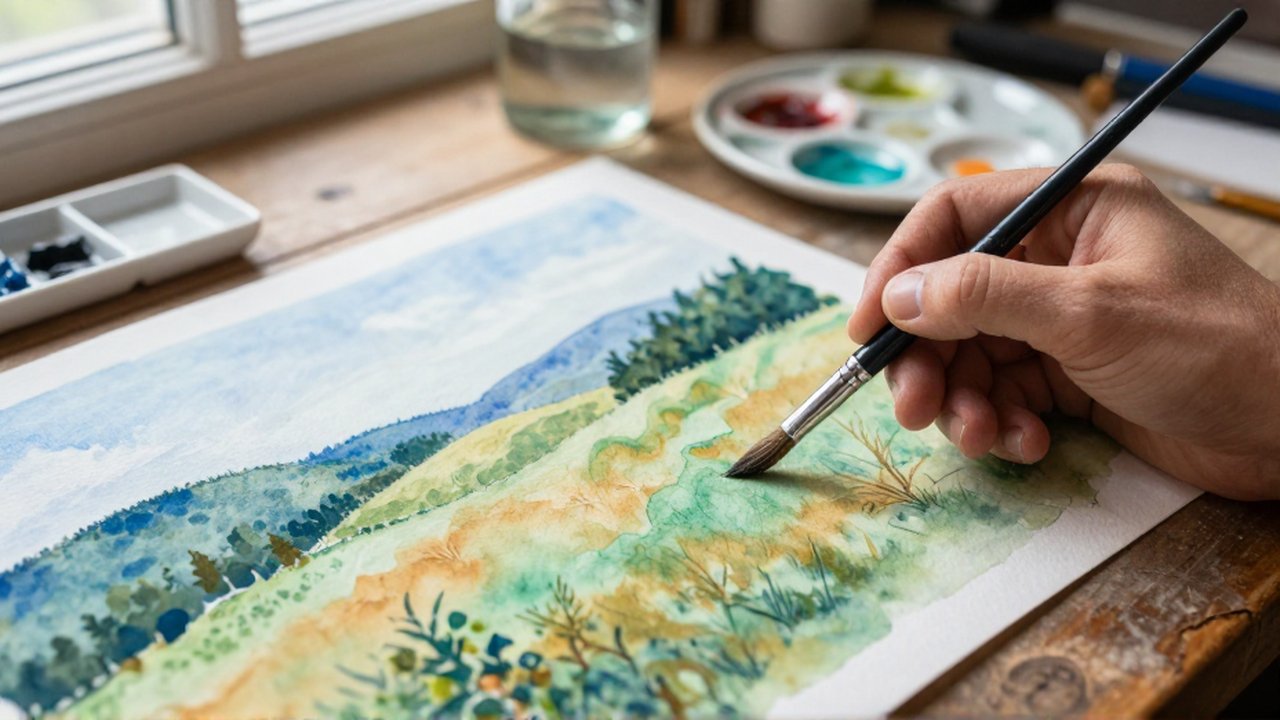
The foundation of any realistic watercolor landscape lies in the ability to manipulate the state of the paper. The two most fundamental approaches are the wet-on-wet and wet-on-dry techniques, which serve different purposes in creating a sense of space and detail.
The wet-on-wet technique involves applying wet pigment onto a surface that has already been dampened with clear water. This is the most effective method for painting skies, distant mountains, and atmospheric effects. Because the pigments spread easily through the water, they create soft, diffused edges that perfectly mimic the look of clouds or distant haze. This technique is crucial for establishing the “background” of a landscape, ensuring that distant elements do not appear too sharp or distracting.
In contrast, the wet-on-dry technique involves applying wet paint onto a completely dry surface. This allows for much higher control and the creation of crisp, defined edges. This approach is indispensable when painting the “foreground” of a landscape, such as individual leaves on a tree, jagged rocks, or the intricate details of a shoreline. By alternating between these two methods, an artist can create a perception of depth, moving from the soft, blurred background to the sharp, detailed foreground.
Layering and glazing for depth and luminosity
Realism in watercolor is often a result of how light interacts with the layers of paint. Unlike oil or acrylic, where light is reflected off the surface of thick pigment, watercolor relies on light passing through transparent layers, hitting the white paper, and bouncing back to the eye. This is known as glazing.
Glazing is the process of applying thin, transparent layers of color over dried, previously applied layers. In landscape painting, this is used to build up complex color shifts. For example, instead of mixing a single green for a forest, an artist might lay down a pale yellow wash, let it dry, and then glaze a thin layer of blue over it. This creates a much more vibrant and naturalistic green that shifts depending on how the light hits the paper.
To successfully use glazing, patience is mandatory. If the bottom layer is not completely dry, the colors will bleed together, resulting in a muddy appearance rather than a luminous one. This technique allows for the subtle modulation of shadows and highlights, enabling the artist to build a realistic sense of volume in hills, trees, and terrain.
Creating texture through dry brush and salt effects

A landscape feels realistic when it possesses a variety of textures that reflect the natural world. A smooth sky should feel different from a rough stone wall or a cluster of distant foliage. Two highly effective ways to achieve this are the dry brush technique and the use of granulating pigments or additives.
The dry brush technique is used to create highlights and rough textures. It is performed by using a brush with very little moisture and a high concentration of pigment, then skimming it quickly across the surface of the paper. The paint only catches on the “tooth” or the tiny bumps of the paper, leaving white gaps in between. This is an excellent way to represent sunlight glinting off water, the texture of tree bark, or the rough edges of a mountain range.
Additionally, artists can manipulate texture using salt or heavy granulation. Sprinkling salt onto a damp wash causes the salt to absorb the pigment, creating starburst patterns that look remarkably like snow, sand, or distant wildflowers. Many professional watercolors are also formulated with heavy pigments that naturally settle into the valleys of the paper, creating a “granulated” effect that is perfect for representing earthy, gritty textures like soil or stone.
Common mistakes to avoid in landscape painting
Achieving realism in watercolor is a balancing act. One of the most frequent errors is the loss of “luminosity” caused by overworking the paper. When an artist repeatedly brushes the same area with a wet brush, the paper fibers begin to break down, and the colors become “muddy.” This happens when too many pigments are mixed on the paper, neutralizing the brightness of the colors.
Another common mistake is the lack of atmospheric perspective. Real landscapes have a clear progression: objects in the distance are lighter, cooler (more blue/grey), and have less contrast, while objects in the foreground are darker, warmer, and sharper. If an artist uses the same intense colors and sharp details for both the distant mountains and the nearby trees, the painting will lose its sense of scale and appear flat.
| Mistake | Result | Solution |
|---|---|---|
| Overworking the wash | Muddy, dull colors | Work quickly and let layers dry completely |
| Lack of value contrast | Flat, lifeless scene | Ensure a range from deep shadows to bright highlights |
| Using too much pigment | Loss of transparency | Use more water to maintain light passage |
Frequently asked questions
How can I prevent my watercolor colors from becoming muddy? To avoid muddiness, refrain from mixing too many different colors in one area and always allow your layers to dry completely before applying a new glaze. Avoid scrubbing the paper with your brush.
What is the best way to paint a realistic sky? The most effective method is the wet-on-wet technique. Dampen the paper first, then drop in soft amounts of pigment, allowing them to bleed into one another naturally to create a soft, atmospheric effect.
How do I achieve very bright highlights in a landscape? In watercolor, the “white” in your painting is actually the white of the paper. To achieve bright highlights, you must plan ahead and leave those areas of the paper completely untouched by paint.
Does the type of paper matter for realistic landscapes? Yes, paper texture significantly impacts the result. A “cold press” paper has a slight texture (tooth) that is excellent for most landscapes, while “rough” paper is even better for creating heavy textures like rocks and bark.

Post Comment