Essential theory for composing Dominican percussion patterns

Introduction
Composing Dominican percussion patterns requires more than just a rhythmic sense; it demands a deep understanding of the syncopation, polyrhythms, and cultural frameworks that define the island’s musical identity. Whether you are scoring for Merengue, Bachata, or Afro-Dominican religious traditions, mastering these patterns allows a composer to create authentic textures that drive movement and emotion. This knowledge is vital for music producers, arrangers, and percussionists seeking to honor traditional roots while applying them to modern compositions.
Understanding these rhythms is particularly important when working in ensemble settings where the percussion must interact seamlessly with melodic instruments. Because Dominican music is deeply rooted in the interplay between different rhythmic layers, knowing the mathematical and stylistic foundations of these patterns ensures that your compositions remain culturally coherent and rhythmically compelling. By grasping the underlying theory, you can move beyond mere imitation and begin to construct original works that breathe with the spirit of the Dominican Republic.
Fundamentals of rhythmic layers and polyrhythms
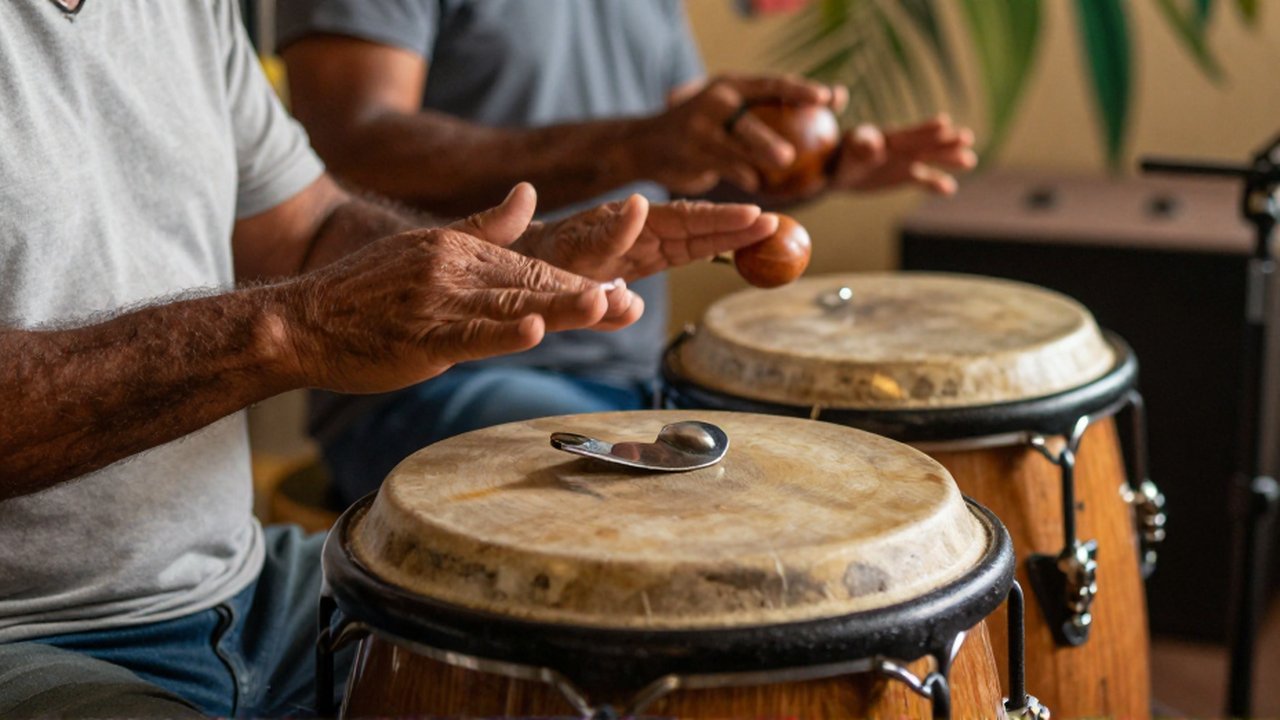
The core of Dominican percussion composition lies in the concept of “interlocking” parts. Unlike Western classical traditions that often rely on a single dominant pulse, Dominican music utilizes multiple rhythmic layers that operate on different subdivisions of the beat. This creates a dense, driving energy known as polyrhythm.
When composing, you must consider the relationship between the steady pulse (often provided by the bass or a constant foot tapping) and the syncopated accents provided by the drums. In genres like Merengue, the percussion is not just keeping time; it is telling a rhythmic story through a combination of the tambora, güira, and accordion melodies. To compose effectively, you must assign specific roles to each instrument: one may provide the subdivision, another the foundational beat, and a third the improvisational “flavor” or accents.
Structural role of the güira and tambora
In most popular Dominican genres, the interaction between the güira and the tambora defines the groove. To compose these patterns, you must understand their distinct sonic and rhythmic functions.
The güira acts as the high-frequency timekeeper. It provides a constant stream of sixteenth or eighth notes, often utilizing scraped textures to create a sense of forward momentum. When composing for the güira, focus on the “swing” or the slight micro-timing shifts that prevent the pattern from sounding mechanical.
The tambora is the rhythmic heart, providing both the low-end punch and the mid-range syncopation. In Merengue, for example, the tambora player alternates between playing on the skin (for a deep tone) and the rim (for a sharp accent). A successful composition will utilize the tambora to “lock in” with the güira’s subdivisions, creating a unified rhythmic engine.
| Instrument | Primary Function | Common Rhythmic Role |
|---|---|---|
| Güira | Subdivision and Texture | Provides constant sixteenth-note movement and high-end shimmer. |
| Tambora | Foundation and Syncopation | Provides the “backbeat” and essential accents that drive the dance. |
| Congas/Bongos | Melodic Rhythm | Adds tonal complexity and bridges the gap between percussion and melody. |
Application of syncopation in Afro-Dominican traditions

If your composition leans toward Afro-Dominican styles, such as those found in Atabales or religious ceremonies, the theory shifts toward more complex, circular patterns. These rhythms are often built on a clave-like structure, where a specific rhythmic cell dictates where the accents fall in the succeeding bars.
In these traditions, syncopation is not an ornament but the foundation. You must avoid placing heavy accents on the “downbeat” (the one) in a way that feels too rigid. Instead, aim to place accents on the “off-beats” or the “ands” of the count. This creates the characteristic “lift” that makes Dominican music so danceable. When composing, think in cycles rather than linear phrases; many Dominican patterns are designed to repeat indefinitely, creating a hypnotic effect through subtle variations.
Common mistakes in rhythmic arrangement
A frequent error when attempting to compose Dominican percussion is “rhythmic crowding.” This occurs when every percussion instrument attempts to play a complex, syncopated pattern simultaneously. This results in a muddy texture where the listener cannot find the pulse. To avoid this, follow the principle of functional hierarchy:
- Assign a “Master” rhythm: Determine which instrument will carry the primary subdivision.
- Leave “Sonic Space”: If the güira is playing very busy sixteenth notes, the tambora should have more space between its hits to allow the pattern to breathe.
- Respect the Pulse: Even in highly syncopated music, the underlying pulse must be felt. If the listener cannot tap their foot to your composition, the syncopation is likely too chaotic.
Frequently asked questions
How do I make a digital percussion track sound more authentic? Avoid quantizing your MIDI notes to a perfect mathematical grid. Dominican rhythms rely on “swing” and micro-timing deviations. Manually shifting certain accents slightly ahead of or behind the beat will mimic the human feel of a live percussionist.
What is the difference between Merengue and Bachata percussion? Merengue is driven by the high-energy, fast-paced interaction of the güira and tambora. Bachata typically uses a more laid-back approach involving the bongo and the güira, with a focus on a specific syncopated pattern that emphasizes the second and fourth beats.
Can I use Western notation to write these patterns? Yes, but standard notation often struggles to capture the nuance of Dominican subdivisions. It is often helpful to use “rhythmic shorthand” or to include a guide for the specific “feel” (such as a swing percentage) to ensure the intent is preserved.

Post Comment