History of landscape painting in Dominican Republic art

Introduction
Landscape painting in the Dominican Republic serves as a visual chronicle of the nation’s diverse topography, shifting light, and evolving cultural identity. This genre allows artists to capture the essence of the Caribbean environment, ranging from the lush, mountainous terrains of the Cordillera Central to the serene, rhythmic coasts of the Atlantic and Caribbean seas. By documenting these physical spaces, landscape painters do more than record scenery; they interpret the soul of the island through color, texture, and composition.
Understanding the evolution of this art form is essential for anyone interested in the intersection of Caribbean nature and human expression. It provides a window into how Dominican artists transitioned from colonial academic styles to modern, expressive interpretations of their homeland. This history is not merely a timeline of scenery, but a narrative of how a nation views its own territory, its climate, and its relationship with the natural world.
Early influences and colonial roots
The origins of landscape representation in the Dominican Republic are deeply tied to the arrival of European artistic traditions. During the colonial era, the focus was largely on religious iconography and portraiture, following the strict dictates of Western academicism. However, even within these structured frameworks, subtle observations of the local environment began to emerge. Early depictions often treated the landscape as a mere backdrop for human or divine subjects rather than a central theme in itself.
As local sensibilities began to diverge from strictly European models, artists started to notice the unique qualities of tropical light. Unlike the soft, diffused light of Europe, the Caribbean sun produces high contrast, intense shadows, and vibrant, saturated hues. This environmental reality eventually forced a shift in technique, as painters realized that traditional European palettes were insufficient to capture the true luminosity of the Dominican landscape.
The emergence of national identity through nature
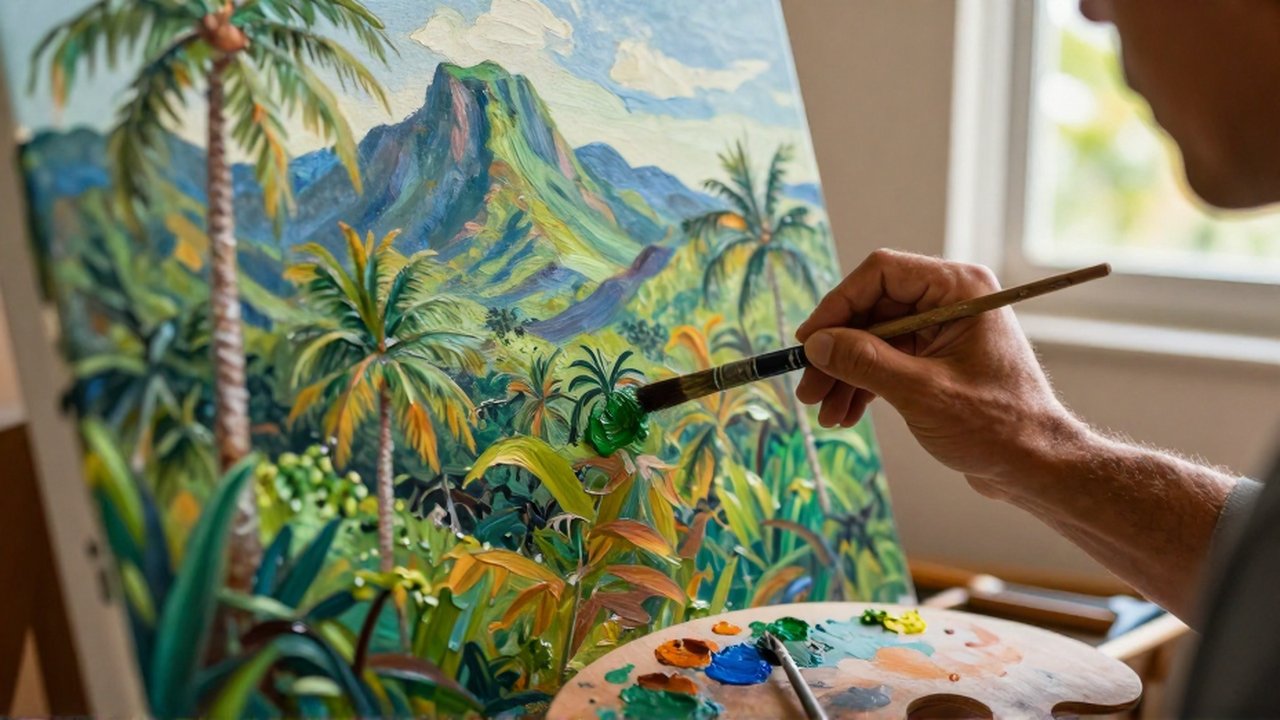
A significant turning point in Dominican art history occurred when painters began to prioritize the land as a symbol of national sovereignty and identity. During periods of political and social transformation, the landscape became a tool for expressing “Dominicanidad”—the essence of being Dominican. Artists moved away from idealized European vistas and toward a more authentic portrayal of the local countryside, rural life, and indigenous flora.
This era saw the rise of artists who focused on the rugged beauty of the interior mountains and the vastness of the tropical plains. By elevating the local landscape to a primary subject, these painters helped build a visual vocabulary that was distinctly Caribbean. The landscape was no longer just a setting; it became a character in the story of the nation, reflecting its resilience, its warmth, and its untamed beauty.
Modernism and the abstraction of the Dominican landscape
With the advent of modernism, the approach to landscape painting underwent a radical transformation. Instead of striving for photographic realism, artists began to experiment with color theory, geometric simplification, and emotional expression. This movement allowed for a more subjective interpretation of the environment, where the “feeling” of a place was more important than its literal appearance.
| Artistic Approach | Characteristics | Focus |
|---|---|---|
| Realism | Detailed textures, accurate lighting, natural colors. | The physical accuracy of the environment. |
| Impressionism | Visible brushstrokes, emphasis on light, vibrant palettes. | The fleeting effects of sunlight and atmosphere. |
| Expressionism | Distorted forms, emotive colors, subjective views. | The emotional response to the landscape. |
| Abstraction | Simplification of shapes, non-traditional color use. | The essence and rhythm of the natural world. |
Modern Dominican masters utilized these styles to deconstruct the landscape. They might use bold, sweeping strokes to represent the movement of the ocean or fragmented shapes to depict the architecture nestled within tropical greenery. This period solidified the landscape as a sophisticated medium for intellectual and artistic exploration.
Contemporary trends and digital evolution

In the contemporary era, landscape painting in the Dominican Republic continues to expand, embracing new technologies and diverse perspectives. While traditional oil and acrylic on canvas remain staples, many artists now integrate mixed media, incorporating local textures like sand, earth, or recycled materials to add a tactile dimension to their work. There is also a growing intersection between traditional painting and digital art, allowing for new ways to manipulate light and perspective.
Contemporary artists often tackle themes of ecology and environmental change. The landscape is no longer just a beautiful view; it is a site of concern regarding climate change, coastal erosion, and the preservation of biodiversity. This adds a layer of urgency and social commentary to the genre, making the modern landscape painting both an aesthetic object and a powerful political statement.
Common misconceptions in landscape art
A frequent mistake when studying this genre is assuming that landscape painting is a passive or “easy” category. Many viewers believe that because the subject is nature, the artist has little to do but copy what they see. In reality, the artist must make complex decisions regarding depth, atmospheric perspective, and color harmony to translate a three-dimensional world onto a two-dimensional surface.
Another misconception is that landscape art lacks human connection. On the contrary, the way an artist chooses to frame a mountain or a coastline reveals their psychological relationship with their homeland. A landscape can convey solitude, joy, struggle, or peace, making it one of the most emotionally resonant forms of visual communication in Dominican culture.
Frequently asked questions
Why is light so important in Dominican landscape painting? The intense, direct sunlight of the Caribbean creates unique color temperatures and high-contrast shadows that require specific technical approaches to capture accurately.
How does landscape painting relate to Dominican identity? By depicting specific local topographies and flora, artists create a visual sense of belonging and celebrate the unique physical characteristics that define the nation.
Is landscape painting still relevant in the digital age? Yes, it remains highly relevant as artists use both traditional and digital tools to explore contemporary issues like environmental conservation and the changing face of the Caribbean.



Post Comment