How to identify traditional Dominican craft marks
Introduction
Identifying traditional Dominican craft marks is an essential skill for collectors, enthusiasts, and travelers seeking to distinguish authentic handiwork from mass-produced imitations. These marks serve as signatures of heritage, indicating the origin, the specific artisan workshop, or the material purity of a piece. Understanding these subtle indicators allows you to appreciate the true value of Dominican craftsmanship and ensures that your acquisitions support the continuation of local artistic lineages.
In a market where globalized manufacturing can easily mimic traditional aesthetics, knowing how to read the “language” of these marks is vital. Whether you are examining Larimar jewelry, intricate wood carvings, or hand-woven textiles, these identifiers provide a layer of transparency and historical context. This guide provides the necessary framework to recognize the hallmarks of quality and authenticity in Dominican artisanal goods.
Importance of authenticity in Dominican crafts

Authenticity in Dominican crafts is not merely about aesthetic value; it is about cultural preservation. Many of the island’s most famous crafts, such as Larimar jewelry and mahogany carvings, are tied to specific geographic regions and ancestral techniques. When you identify a legitimate maker’s mark or a certification of origin, you are confirming that the item was produced using methods passed down through generations.
Furthermore, identifying these marks protects your investment. Authentic pieces made from genuine local materials—such as high-grade Larimar or authentic Cibao Valley wood—hold their value far better than synthetic substitutes. Recognizing the difference between a stamped workshop mark and a generic manufacturer’s label is the first step in becoming a discerning collector of Caribbean art.
Common types of marks in Dominican artistry
Dominican artisans use several different methods to mark their creations, depending on the medium and the level of formality of the workshop. Knowing these types helps you know where to look on an object.
Workshop stamps and engraver marks In metalwork or high-end jewelry, especially involving Larimar or gold, you may find tiny, stamped symbols. These are often located on the interior of a ring, the clasp of a necklace, or the base of a small silver vessel. These stamps represent the jeweler’s brand or the specific cooperative that produced the item.
Hand-applied signatures In the realm of fine arts and high-quality wood carvings, signatures are often hand-painted or etched directly into the medium. Unlike industrial stamps, these are slightly irregular and unique to the individual artist. A hand-carved wooden figure from San Cristóbal might feature a subtle etching at the base that serves as the artist’s personal seal.
Material certifications For stones like Larimar, authenticity is often verified not by an artist’s name, but by a certificate of origin or a specific type of mounting that adheres to traditional Dominican jewelry standards. While not a “mark” in the literal sense of a stamp, these documents act as the definitive identifier of the piece’s legitimacy.
Steps to verify handmade goods

To effectively identify traditional marks, you should follow a systematic approach when inspecting an item.
- Inspect high-friction areas: On jewelry, look at the inside of bands or the underside of pendants. On ceramics or woodwork, examine the base or the bottom rim.
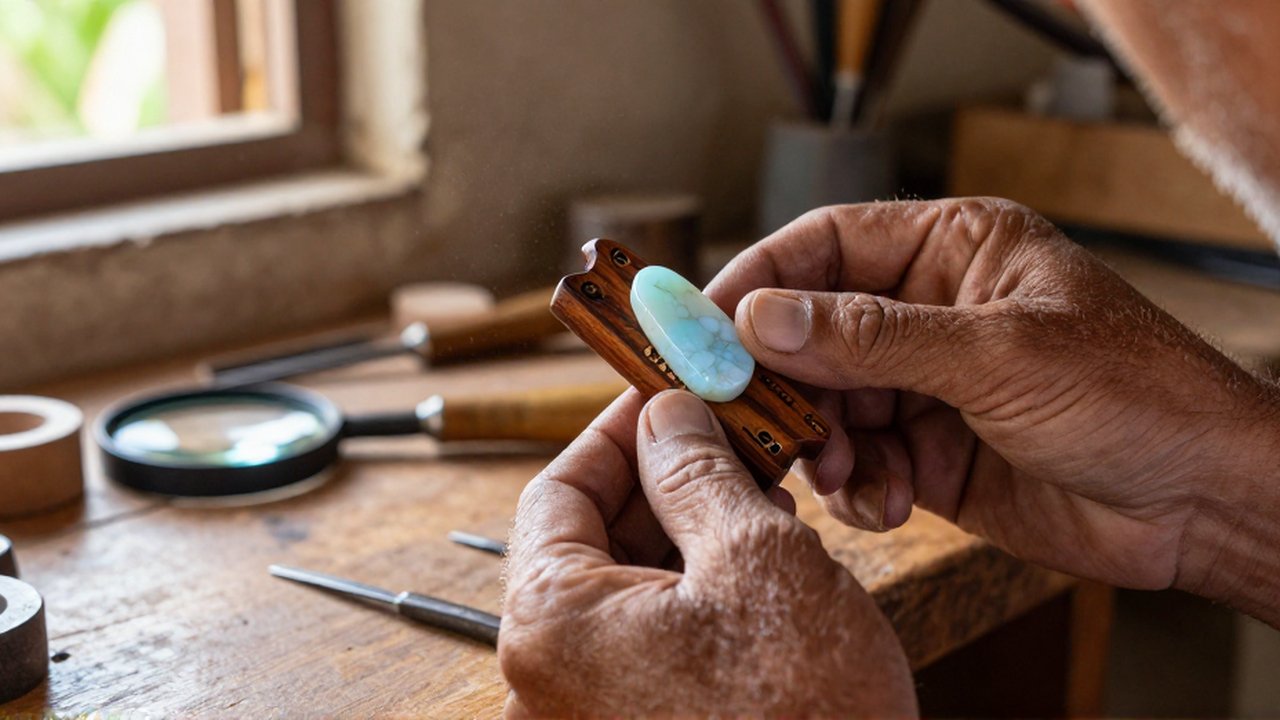
- Use magnification: Many traditional marks are incredibly small to avoid distracting from the artwork. A small magnifying glass can reveal a jeweler’s hallmark that is invisible to the naked eye.
- Compare texture and depth: A genuine hand-stamped mark will often have slight irregularities in depth and alignment. In contrast, a laser-etched or machine-printed mark will appear perfectly uniform and “too perfect.”
- Check for consistency with the material: Does the mark make sense for the medium? For example, a deep, aggressive stamp on a delicate piece of Larimar would be unusual, whereas a fine engraving on gold is standard.
Typical errors when searching for marks
A frequent mistake is assuming that the absence of a mark automatically signifies a fake. In some traditional rural workshops, artisans may prioritize the craft over the branding, leaving pieces unmarked to focus entirely on the material. In these cases, authenticity must be judged by the quality of the technique and the natural characteristics of the material.
Another error is confusing mass-produced “souvenir” marks with artisan hallmarks. Many commercial gift shops use generic stamps that claim “Made in Dominican Republic” as a way to appeal to tourists. These are commercial labels, not artisan marks. A true craft mark identifies the maker or the source, whereas a commercial label only identifies the location.
Frequently asked questions
Where is the most common place to find a jeweler’s mark? In Dominican Larimar or silver jewelry, the mark is most commonly found on the inside of a ring band or on the small metal tag attached to a necklace chain.
Can I trust a mark that looks perfectly identical to another piece? If the mark is perfectly uniform and lacks any slight variation in depth or character, it may be machine-stamped. While some professional workshops use standardized stamps, hand-crafted pieces often show the subtle touch of the tool used.
What should I do if a piece has no visible mark? If there is no mark, evaluate the material and the technique. If the item is a high-quality wood carving or textile, look for the “feel” of the work—the weight, the scent of the wood, and the complexity of the pattern—which can often serve as an indicator of authenticity.



Post Comment